Between 2023 and 2026, the conditions that supported traditional, spreadsheet-based demand forecasting fundamentally collapsed. Supply chain disruptions transitioned from quarterly exceptions to monthly realities, and tariff policies began shifting with unprecedented speed. In this hyper-volatile environment, relying on single-point historical forecasts is a massive financial liability.
Dynamic demand forecasting represents the evolution of FP&A (Financial Planning and Analysis). It is the practice of utilizing advanced analytics, artificial intelligence, and granular SKU-level data to make faster, financially informed inventory commitments before capital is locked up.
1. The Shift to Decision-Centric Platforms
The primary limitation of traditional forecasting is its isolation from actual financial outcomes. In 2026, demand planning solutions are no longer just statistical prediction tools; they are decision-centric platforms embedded with deep financial intelligence.
This allows financial executives and demand planners to view the true cost of inventory decisions in real time. Broad, top-line forecasts are useful for executive summaries, but the real financial risk and opportunity reside deeper in the data—at the SKU (Stock Keeping Unit) level. Modern systems provide visibility at this granular level, allowing teams to optimize carrying costs and mitigate tariff uncertainty before purchase orders are signed.
2. Multi-Scenario Planning vs. Single-Point Forecasts
An «excellent» single-point forecast is one that happens to be highly accurate for a brief, specific moment. However, planners who spend excess hours fine-tuning a single spreadsheet prediction will likely miss the actual demand cycle, invalidating the forecast entirely.
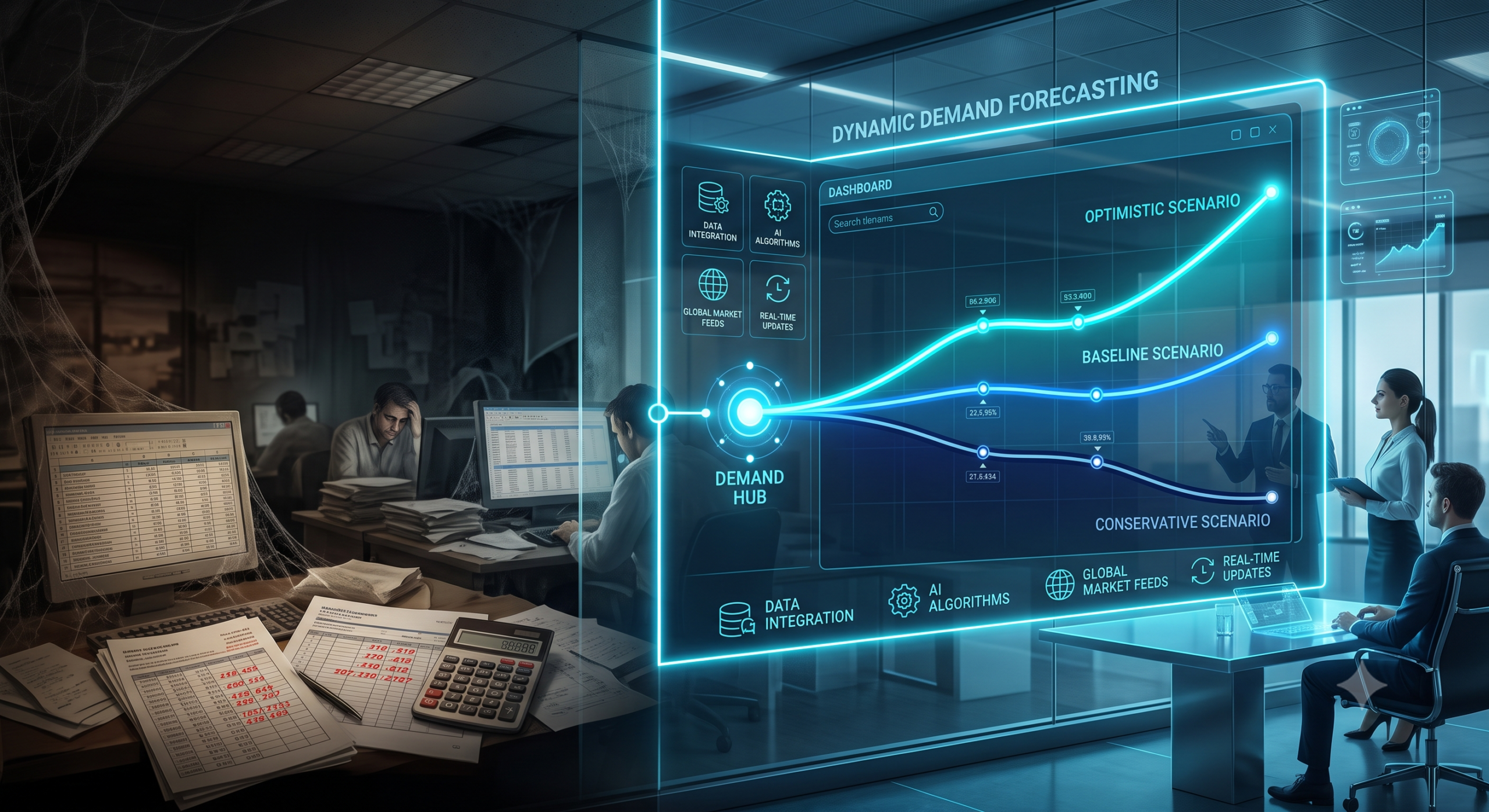
To survive, speed must be prioritized alongside accuracy. Leading demand planning processes have abandoned single-point predictions in favor of simultaneous scenario planning, which includes:
- The Baseline Scenario: The most mathematically likely outcome given current, real-time information.
- The Optimistic Scenario: A model planning for stronger-than-expected consumer demand or highly favorable supply conditions.
- The Conservative Scenario: A model accounting for delayed shipments, raw material shortages, or sudden drops in purchasing power.
Sophisticated tools allow organizations to evaluate the direct inventory and cash-flow implications of all three scenarios simultaneously, making it operationally feasible to switch strategies instantly.
3. The Human-AI Forecasting Loop
Artificial intelligence excels at pattern recognition at massive scale, easily handling millions of data points across thousands of product lines. However, AI lacks business context.
Advanced demand planning processes layer human judgment directly on top of AI-generated forecasts. The AI provides the statistical baseline and flags significant deviations in purchasing behavior. Financial planners then review these flags, apply qualitative business context (such as an upcoming unannounced marketing campaign), and manually adjust the final capital allocation.
💬 Analyst’s Point of View
When transitioning from manual spreadsheets to dynamic planning platforms, what was the biggest hurdle for your FP&A team? Was it cleaning the historical SKU data, or convincing leadership to trust multi-scenario outputs over a single «safe» number?
Frequently Asked Questions (FAQ)
What is the first step to modernize a demand forecasting process? The immediate first step is technological adoption. If an organization is still managing demand forecasts in manual spreadsheets, they cannot execute dynamic scenario planning. Moving to a cloud-based, centralized platform is mandatory before addressing workflow frequency or team skills.
How frequently should a dynamic forecast be updated? Unlike annual budgets, dynamic forecasts operate on a continuous planning loop. Depending on the industry’s volatility, best-in-class organizations update their baseline scenarios weekly, or even daily, integrating real-time point-of-sale data and supply chain lead times.