
From Chatbots to Autonomous Execution: The Dawn of Agentic AI in Finance and Data Analytics
The financial services sector has long been a pioneer in adopting new technologies to process vast amounts of information. Over the past decade, the industry has aggressively integrated predictive analytics to assess credit risk and adopted generative artificial intelligence to summarize earnings reports and draft customer communications. However, these tools share a fundamental limitation: they are passive. They calculate probabilities or generate text, but they wait for a human to interpret the output and pull the trigger.
As we progress through 2026, the financial technology landscape is undergoing a structural paradigm shift driven by a new evolution in artificial intelligence: Agentic AI.
Unlike its predecessors, Agentic AI does not simply answer questions; it takes action. It represents a transition from AI as a «copilot» to AI as an autonomous agent capable of perceiving its environment, reasoning through complex multi-step problems, executing decisions across disparate software systems, and adapting to unexpected anomalies—all with minimal human supervision. This comprehensive guide explores the architecture of Agentic AI, its high-impact applications in financial workflows, the underlying data infrastructure required to support it, and the critical governance frameworks necessary to deploy autonomous systems responsibly.
Defining the Paradigm Shift: What Exactly is Agentic AI?
To fully grasp the magnitude of Agentic AI, it is essential to contrast it with the automation technologies that finance and data teams have relied on for the past two decades.
Traditional Robotic Process Automation (RPA) is excellent at moving data rapidly from one system to another, provided the rules are hardcoded and the environment is entirely static. However, RPA is fundamentally brittle. If an invoice format changes or a data field is missing, the RPA bot immediately breaks and halts the workflow, requiring human intervention.
Generative AI, such as conversational chatbots, represents a leap in understanding unstructured data. These models can parse complex language, draft emails, and write code. Yet, they are confined to a chat interface. They require constant, step-by-step prompting and lack the ability to chain actions together across external systems independently.
Agentic AI bridges the gap between deep cognitive reasoning and dynamic execution. When a finance manager assigns an objective to an AI agent—such as, «Reconcile our intercompany receivables across these five international entities for Q2″—the agent does not ask for a step-by-step script. Instead, it leverages large language models (LLMs), retrieval-augmented generation (RAG), and multi-agent frameworks to:
- Plan: It breaks the overarching goal into logical subtasks.
- Execute: It queries the necessary databases, calls APIs to log into multiple ERP (Enterprise Resource Planning) systems, and pulls the relevant ledgers.
- Reason: It cross-references the data, identifying mismatches and currency discrepancies.
- Adapt: If a specific API times out, it retries or searches for an alternative data route.
- Resolve: It drafts the necessary correction journals and surfaces only the complex, ambiguous exceptions to a human controller.
This level of autonomy transforms AI from a basic software tool into a functional digital worker capable of managing end-to-end processes.
How Agentic AI is Rewiring Core Financial Operations
The deployment of Agentic AI is moving rapidly from experimental sandboxes into core production environments. Financial institutions, holding companies, and high-growth fintechs are leveraging this technology to eliminate bottlenecks in high-volume, data-heavy operations.
Autonomous Financial Reconciliation and Month-End Close
The month-end close is notoriously grueling, traditionally forcing accounting teams to spend days manually matching thousands of transactions across bank feeds, accounts payable records, and the general ledger. Agentic AI is shifting this from a frantic monthly scramble to a continuous, real-time process. Agents continuously ingest financial feeds, apply dynamic matching logic, and identify timing differences versus genuine accounting errors. Crucially, when an agent flags a discrepancy, it provides the human reviewer with the full context—explaining what it found, why it could not resolve the issue autonomously, and precisely what information is needed to close the loop. Early enterprise adopters report up to a 50% reduction in the time required to close the books.
Intelligent Accounts Payable (AP) and Invoice Processing
Traditional AP automation relies on optical character recognition (OCR) templates. If a vendor changes their invoice layout, the template fails. Agentic AI systems approach invoice processing dynamically. They receive an invoice via email, extract line items regardless of the format, and perform complex three-way matching against purchase orders and warehouse receipts. If a threshold is met, the agent routes the invoice for approval, posts it to the ledger, and schedules the disbursement. For major enterprises, this is resulting in straight-through processing rates exceeding 85%, significantly reducing late payment penalties and duplicate billing errors.
Real-Time Fraud Detection and AML Compliance
In the realm of financial crime, fraud patterns evolve daily, making static, rule-based detection systems obsolete. Furthermore, legacy systems generate massive volumes of false positives, overwhelming human investigators. Agentic AI addresses this by acting as a first-line investigator. When a suspicious transaction occurs, the agent instantly pulls data from multiple internal and external systems to build a contextual profile of the event. It reasons through the variables, scores the risk, and drafts a comprehensive summary for the human analyst, drastically reducing the time-to-resolution and lowering the cost per case without increasing risk exposure.
Dynamic Cash Flow Forecasting and Scenario Modeling
Predictive analytics tools typically forecast outcomes based on historical trends. Agentic AI takes this further by actively pulling real-time signals from external markets, macroeconomic indicators, and internal supply chain lead times. Instead of presenting a static quarterly forecast, AI agents continuously update cash flow projections. If a geopolitical event disrupts a major shipping route, the agent autonomously recalculates the localized pricing impact, adjusts revenue projections, and presents the Chief Financial Officer with alternative capital allocation strategies.
Building the Infrastructure: The Unglamorous Reality of AI
While the capabilities of Agentic AI sound revolutionary, deploying these systems successfully requires a grueling commitment to data architecture. As researchers from leading institutions have noted, the biggest challenge in implementing AI agents is not prompt engineering or fine-tuning the foundational models; rather, 80% of the effort is consumed by data engineering, standardizing formats, and stakeholder alignment.
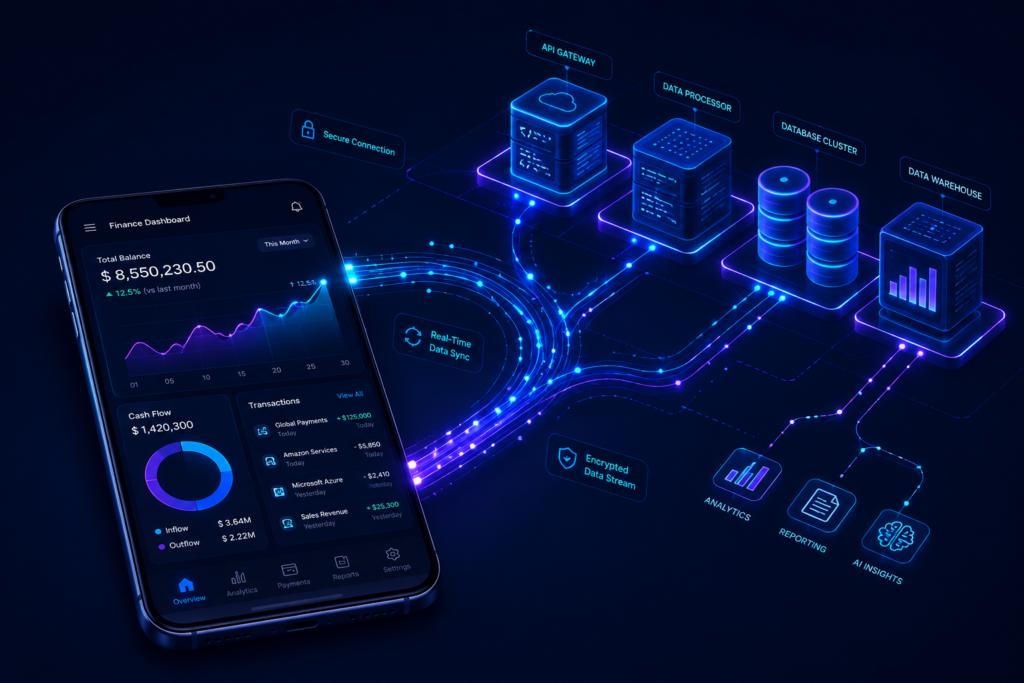
An AI agent cannot execute a task if it cannot access or understand the data. For Agentic AI to function, financial institutions must build modern, scalable data platforms. This involves breaking down internal data silos, migrating legacy on-premise databases to secure cloud environments, and implementing semantic layers that define business metrics consistently across the organization.
If a company’s data is unstructured, incomplete, or plagued by poor naming conventions, an autonomous agent will inevitably make flawed decisions at a highly accelerated pace. The foundational rule of data analytics—»garbage in, garbage out»—is exponentially magnified when the system is capable of executing actions autonomously. Therefore, organizations must invest heavily in data readiness, metadata labeling, and continuous data quality monitoring before handing the keys to an AI agent.
The Governance Challenge: Deploying Autonomous Systems Responsibly
The financial services industry is one of the most heavily regulated sectors in the global economy. Allowing an AI to make independent financial decisions introduces significant model risk, compliance exposure, and ethical concerns regarding bias. Transitioning from passive analytics to agentic execution demands a complete modernization of corporate governance.
To scale Agentic AI responsibly, institutions must implement stringent guardrails:
- Human-in-the-Loop (HITL) Thresholds: AI agents should not operate with unchecked authority. Organizations must define clear operational boundaries. For example, an agent might have the autonomy to approve routine vendor payments up to $10,000, but any transaction above that threshold, or any transaction flagged with a moderate risk score, must be escalated to a human controller.
- Explainability and Audit Trails: In finance, an answer is only valid if you can prove how you arrived at it. Agentic systems must generate immutable audit logs for every decision they make. If an agent denies a credit application or flags a transaction for money laundering, compliance officers and regulators must be able to trace the agent’s logic back to the exact source documents and data points it used.
- Evaluation Harnesses and Drift Monitoring: Financial markets are dynamic. An AI agent that performs flawlessly in Q1 might begin making erratic decisions in Q3 due to «model drift» caused by changing economic conditions. Firms must establish continuous regression testing and monitoring dashboards to detect when an agent’s performance degrades, accompanied by clear «kill-switch» protocols to suspend the agent if it behaves unpredictably.
- Data Security and Access Controls: Because AI agents operate across multiple systems, they require extensive API access. Strict role-based access control (RBAC) and encryption protocols must be enforced to ensure agents cannot inadvertently expose Personally Identifiable Information (PII) or execute actions outside their designated scope.
The Strategic Impact: Elevating the Role of the Financial Analyst
A common, yet misplaced, fear surrounding automation is that AI will render the human workforce obsolete. History demonstrates that technology redefines work rather than eliminating it. Agentic AI is poised to execute the heavy lifting of data aggregation, cleansing, and basic reconciliation—tasks that currently consume up to 70% of an analyst’s time.
By absorbing this operational burden, Agentic AI elevates the role of the finance professional. Analysts will transition from being manual number-crunchers to strategic business partners. Their day-to-day work will shift toward interpreting the nuanced insights generated by AI agents, managing complex exceptions, advising executive leadership on capital allocation, and overseeing the ethical governance of the AI systems themselves. The organizations that thrive in the coming decade will not be those that replace humans with AI, but those that successfully augment human judgment with autonomous execution.
Frequently Asked Questions (FAQ)
What is the core difference between Generative AI and Agentic AI? Generative AI (like standard ChatGPT) is primarily conversational and passive; it answers prompts, summarizes text, and generates content, but it stops there. Agentic AI is goal-oriented and active. It can understand a complex objective, plan a multi-step workflow, log into external software systems (like ERPs or CRMs), execute tasks, and adapt to errors without needing a human to prompt every single step.
Will Agentic AI operate completely without human supervision? In highly regulated industries like finance, fully autonomous operation without oversight is highly unlikely and legally precarious. The industry standard is the «Human-in-the-Loop» (HITL) model. AI agents will handle the vast majority of routine, high-volume processing, but they will be programmed to escalate edge cases, high-value transactions, and ambiguous anomalies to human experts for final approval.
How does an AI Agent handle regulatory compliance and audits? Responsible Agentic AI platforms are built with deep observability. Unlike «black box» models, enterprise agents generate detailed, plain-language audit logs for every action they take. If a regulator questions why a specific trade was routed or why an invoice was approved, the system can instantly produce an evidence trail linking the decision to specific rules, emails, and data points.
Is Agentic AI only accessible to massive enterprise banks? No. While large institutions are building proprietary agentic frameworks, the democratization of AI through cloud platforms and specialized fintech SaaS providers means that mid-market companies and startups can easily access these capabilities. Many modern accounting and analytics platforms now feature built-in AI agents that require zero custom coding to deploy.
Community Perspective: What is Your Take?
The transition from software that tells us what is happening, to software that actually does the work for us, represents a monumental shift in corporate trust and culture.
As data professionals and finance leaders, how comfortable are you with the concept of Agentic AI? Would you trust an autonomous agent to execute real-time trades, reconcile your company’s general ledger, or communicate directly with your vendors? Where do you draw the line between helpful automation and the need for human intuition?
Drop a comment below sharing your firsthand experience or reservations regarding autonomous financial systems. Your insights are what drive our tech community forward!