
Corporate financial management is crossing a structural tipping point. For decades, the planning of Operational Expenditures (OPEX) has relied on static budgets, linear percentage adjustments over historical data, and fragmented spreadsheets. However, in the 2026 economy, where market volatility and supply chain disruptions are the norm, relying exclusively on retrospective analysis is insufficient.
This is where Predictive OPEX Modeling redefines the industry standard. This technical guide, designed for data analysts, Chief Financial Officers (CFOs), and operations managers, objectively explores what this methodology is, how it is mathematically structured, and why it has become the cornerstone of modern financial efficiency.
1. What is Predictive OPEX Modeling?
To understand the impact of predictive modeling, we must first isolate the concept of OPEX. Operational Expenditures represent the ongoing costs required for the day-to-day running of a business: payroll, rent, software licenses, marketing campaigns, and IT infrastructure maintenance. Unlike CAPEX (Capital Expenditures), OPEX is recurring and often highly susceptible to unforeseen fluctuations in demand or inflation.
Predictive OPEX Modeling is the application of data science, advanced statistics, and Machine Learning algorithms to forecast future operational expenses based on the correlation of multiple variables (both internal and external). Instead of assuming that this year’s marketing costs will equal last year’s plus a 5% inflation rate, a predictive model analyzes the correlation between media investment, projected acquisition costs, macroeconomic trends, and historical seasonality to generate a dynamic, risk-adjusted forecast.
2. The Technical Architecture of a Predictive Model
Building a robust model requires moving away from intuition and strictly relying on data-driven evidence. The architecture of these predictive systems is divided into three fundamental layers:
A) Data Ingestion and Cleansing (Data Pipeline)
A predictive model is only as accurate as the data that feeds it. The first step involves integrating isolated data sources through ETL (Extract, Transform, Load) processes. This includes unifying the financial ERP, the CRM, cloud billing platforms, and external macroeconomic indicators (such as consumer price indices or interest rates).
B) Algorithmic Engine and Mathematical Modeling
The core of the prediction lies in statistical and algorithmic analysis. Depending on organizational complexity, data scientists apply everything from multiple regressions to neural networks.
At the foundation of time series forecasting for recurring operational expenses, it is common to use autoregressive (AR) models, whose foundational mathematical formulation is expressed as:
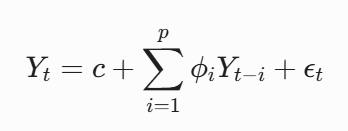
Where Yt represents the operational expense estimate in the current period, c is a constant, p is the order of the model (number of historical lags), phi are the model parameters that weight the importance of previous months, and epsilon_t represents white noise or stochastic variance (the unpredictable margin of error). The objective of Machine Learning is to minimize that variance epsilon_t by iteratively adjusting the parameters.
C) Continuous Variance Analysis (Rolling Forecast)
Unlike the annual budget, predictive modeling is not an exercise performed once a year. It is a Rolling Forecast process. The model constantly compares the actual executed OPEX against the projected OPEX, learns from the deviation (variance), and automatically recalibrates the forecasts for the upcoming quarters.
3. Use Cases and Practical Business Application
The implementation of these methodologies impacts a wide variety of departments, breaking down information silos:
- Cloud and IT Infrastructure Optimization: Cloud costs are among the most volatile OPEX. Predictive models analyze historical peaks in web traffic and server usage to forecast the exact capacity demand required in the next quarter, avoiding both over-provisioning and under-utilization.
- Personnel Costs (Headcount & Payroll): Forecasting labor OPEX is not merely adding up salaries. Predictive algorithms integrate variables such as the company’s historical turnover rate, average time-to-hire, recruitment costs, and local wage inflation to accurately project the cash flow needed to sustain the workforce.
- Marketing and Acquisition Spend (CAC): Models analyze the law of diminishing returns in advertising. They foresee the exact point at which an increase in the Paid Media budget will cease to be efficient, thereby optimizing capital allocation.
Meeting Point & Analyst’s Perspective:
In your experience managing operational budgets or analyzing financial deviations, what do you consider to be the greatest challenge when abandoning the traditional spreadsheet? Is it the cultural resistance of executive teams to trust algorithms, or the technical difficulty of ensuring the quality and cleanliness of historical data? We are interested in knowing your practical approach in the comments section.
4. Frequently Asked Questions (FAQ) Regarding OPEX Modeling
Does Predictive OPEX Modeling guarantee direct cost reduction?
No. Financial compliance and reporting policies are clear: no analytical tool guarantees cost reduction on its own. Predictive modeling provides visibility, diagnosis, and anticipation. OPEX reductions only materialize if the operations team uses this intelligence to make disciplined strategic decisions and execute real-world adjustments.
Is an in-house Data Science team necessary to implement it?
Historically, yes, but the current ecosystem of Embedded Finance and financial corporate SaaS (Software as a Service) platforms include out-of-the-box predictive modules. These platforms automate algorithmic selection, allowing financial analysts to operate the models without needing to program from scratch in Python or R.
How do these models handle anomalous events or «Black Swans»?
Purely historical models fail in the face of unprecedented events. Therefore, modern predictive platforms allow for Scenario Planning. The analyst can inject stress variables (for example: «What happens to our logistics OPEX if fuel prices rise by 30% in two weeks?») to evaluate the impact and create documented contingency plans.