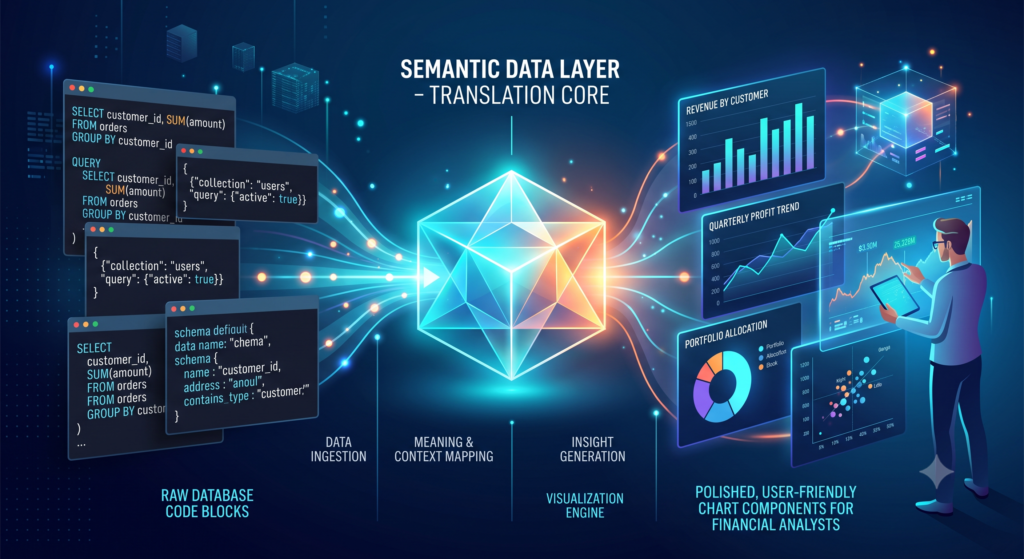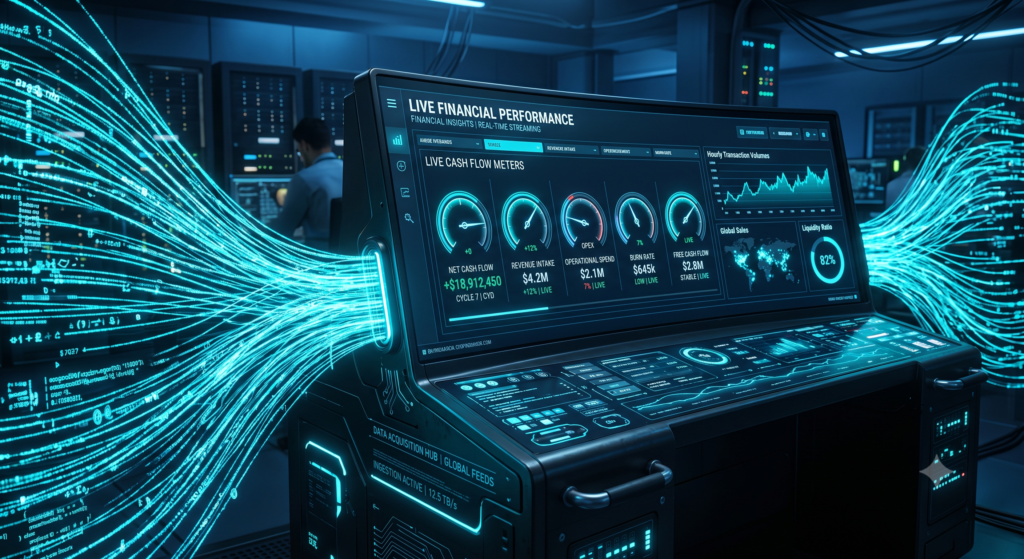
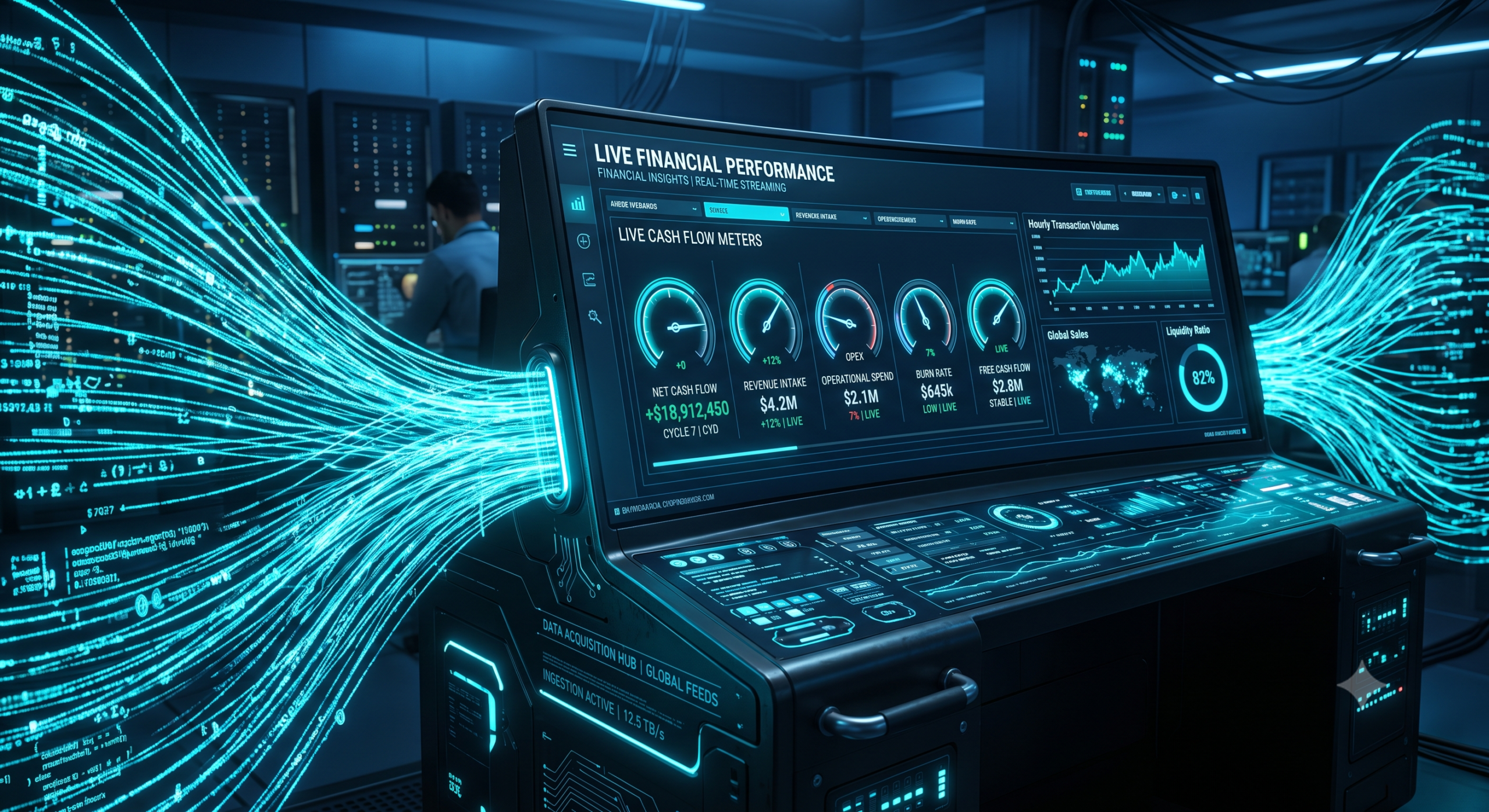
In volatile economic environments, traditional monthly or quarterly accounting cycles leave executive teams operating with outdated information. A sudden drop in collections, an unexpected spike in operational expenses, or a tightening of credit terms can severely compromise cash positions before traditional reports flag the issue. Real-time financial KPI tracking shifts corporate monitoring from retrospective reviews to live, streaming operational awareness.
This article details the technical frameworks, data streaming pipelines, and metric selection criteria required to build low-latency financial tracking systems that deliver continuous visibility into corporate liquidity.
1. The Transition to Streaming Financial Analytics
Traditional business intelligence relies on batch processing: data is extracted from transactional databases at scheduled intervals (such as midnight or month-end) and loaded into a reporting store. While sufficient for high-level historical reviews, batch processing creates latency gaps during rapid market shifts.
Real-time financial analytics replaces batching with event-driven data streaming. Every transaction—a customer credit card payment, a vendor invoice approval, or an automated payroll debit—emits an event that flows directly into the analytics engine. This enables finance teams to monitor intraday cash movements, track working capital velocity, and detect operational anomalies as they occur.
[ Transaction Source ] ---> [ Event Stream (Kafka / Webhooks) ] ---> [ Real-Time Analytics Engine ] ---> [ Live Dashboard ]
2. Essential Real-Time Financial Metrics
Not all financial metrics benefit from real-time tracking. Long-term structural metrics like annual return on capital or quarterly tax provisions do not shift meaningfully on an intraday basis. Real-time tracking should focus strictly on high-velocity liquidity and operational indicators:
Intraday Cash Balance and Net Position
Tracks live bank account balances across all operating accounts, accounting for pending debits and cleared deposits. This prevents overdraft fees and optimizes overnight money-market sweeping.
Real-Time Accounts Receivable (AR) Settlement
Monitors invoice payments as they clear through banking gateways. Tracking real-time settlement velocity helps identify payment gateway failures or sudden delays in major client remittances.
Working Capital Velocity and Burn Rate
Measures the precise rate at which operational cash is consumed against daily revenue collection. In fast-growing enterprises or capital-intensive operations, tracking daily burn rate variations prevents sudden liquidity crunches.
3. Technical Streaming Architecture: Webhooks, Kafka, and Cloud Warehouses
Building a low-latency financial pipeline requires decoupling the data collection layer from the analytical presentation layer to maintain system stability.
+--------------------------+
| Enterprise Transactions  |
| (ERPs, Banking Gateways) |
+------------+-------------+
             |
             | [Event Emission via Webhooks / Change Data Capture (CDC)]
             v
+--------------------------+
| Streaming Message Bus    |
| (Apache Kafka / PubSub)  |
+------------+-------------+
             |
             | [Real-Time Stream Processing]
             v
+--------------------------+
| Cloud Analytics Engine   |
| (Snowflake / BigQuery)   |
+------------+-------------+
             |
             | [Low-Latency API Push]
             v
+--------------------------+
| Live Financial Dashboard |
+--------------------------+
Change Data Capture (CDC)
Instead of running heavy SQL queries against production ERP databases, systems utilize CDC technology (such as Debezium). CDC reads the transaction logs of the underlying database directly, emitting an event the exact millisecond a record is created or modified without impacting database performance.
Streaming Platforms
Message brokers like Apache Kafka or AWS Kinesis ingest thousands of concurrent financial events per second, queuing them safely for processing.
Stream-Processing Analytics Engines
Tools like Apache Flink or specialized cloud data warehouse streaming pipelines ingest the message queue, calculate running totals and averages on the fly, and push the updated metrics to the user dashboard using WebSockets.
💬 Interactive Perspective: Your Experience
When managing high-volume operations, live ticket distributions, or fast-paced budget launches, data spikes can easily distort financial visibility. How does your team handle real-time data ingestion? Do you utilize automated event streaming to capture instant updates, or do you rely on scheduled daily batch refreshes to filter out operational noise?
4. Frequently Asked Questions (FAQ)
Does real-time tracking create unnecessary operational noise? It can if thresholds are set incorrectly. The goal of real-time tracking is not to react to every minor micro-transaction, but to detect systemic shifts intraday. Implementing smoothing algorithms (such as rolling 4-hour averages) helps eliminate noise while preserving low latency for critical alerts.
How do real-time pipelines maintain security across open API connections? Streaming pipelines enforce strict end-to-end security protocols, including TLS 1.3 encryption for data in transit, mutual TLS (mTLS) for API endpoint authentication, and tokenized payloads to ensure sensitive customer or banking details are never exposed in unencrypted event logs.