
The financial technology landscape is evolving at a breakneck pace. Startups and established enterprise institutions alike are under immense pressure to launch digital products faster, handle massive datasets in real-time, and provide seamless user experiences. However, building the underlying infrastructure to support these applications—managing servers, databases, security protocols, and user authentication—is historically a slow, expensive, and resource-heavy endeavor.
This is where the paradigm of modern software development shifts. Enter Backend-as-a-Service (BaaS), a cloud computing model that abstracts the complexities of server-side infrastructure, allowing developers to focus entirely on the frontend user experience. By outsourcing the digital «plumbing,» financial technology companies and data analytics platforms can drastically reduce their time-to-market while maintaining enterprise-grade scalability.
In this comprehensive guide, we will explore the architecture of Backend-as-a-Service, distinguish it from its FinTech homonym (Banking-as-a-Service), and break down how it is revolutionizing the way we build data-driven financial applications today.
Clarifying the Acronym: Backend vs. Banking
Before diving into the technical architecture, it is crucial to address a common point of confusion within the financial technology sector. The acronym «BaaS» serves two distinct, yet highly complementary, purposes in FinTech:
- Backend-as-a-Service: A cloud computing model (which is the focus of this article) where a third-party vendor provides web and mobile app developers with a way to link their applications to backend cloud storage and APIs. It handles the server infrastructure.
- Banking-as-a-Service: A financial model where licensed banks integrate their digital banking services directly into the products of other non-bank businesses.
While they are different concepts, they often intersect. A modern FinTech startup might use Banking-as-a-Service to legally issue debit cards, while relying on Backend-as-a-Service to host the app’s user database and power its serverless computing architecture.
What Exactly is Backend-as-a-Service?
To understand Backend-as-a-Service, consider the analogy of opening a high-end restaurant. As the owner, you want to focus on the dining room experience: the menu, the ambiance, and customer service (this represents your application’s frontend). Building a traditional backend is like having to pour the concrete foundation, construct the building, wire the electricity, and install the plumbing before you can cook a single meal.
BaaS is the equivalent of leasing a fully built, state-of-the-art commercial kitchen. Everything is already installed and maintained by the landlord. You simply bring your ingredients and start cooking.
In software terms, a BaaS provider supplies pre-written software for activities that take place on servers. This includes user authentication, database management, remote updating, push notifications, and cloud storage. Developers access these services through Application Programming Interfaces (APIs) and Software Development Kits (SDKs), seamlessly connecting their frontend code (built in React, Swift, or Vue) to a robust, invisible backend.
Traditional Monolithic Servers vs. Serverless BaaS
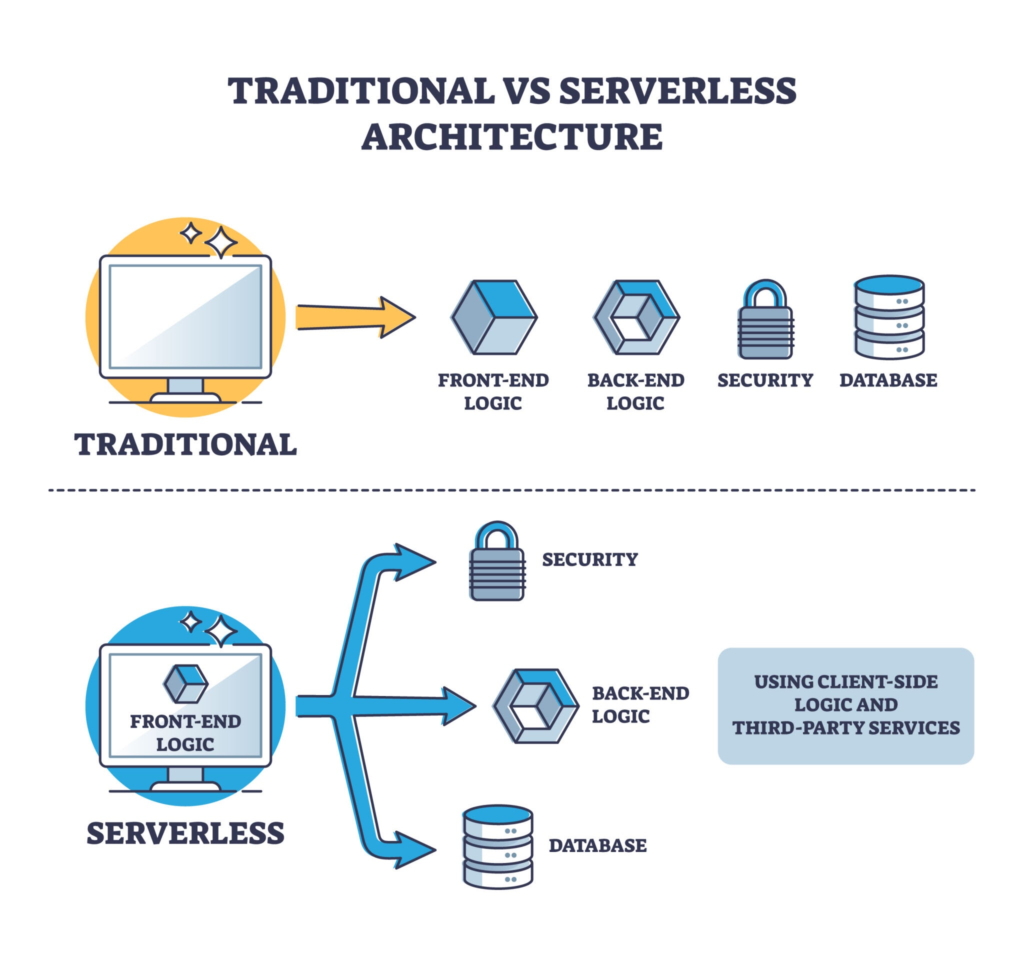
Historically, deploying an application required provisioning and managing physical or virtual servers. Developers had to guess the amount of bandwidth and storage they would need. If an app went viral and traffic spiked, the server would crash. If traffic was low, the company was still paying for unused server capacity.
BaaS operates heavily on a serverless architecture. The term «serverless» does not mean servers do not exist; it means the management, provisioning, and scaling of those servers are entirely invisible to the developer.
In a serverless BaaS environment, resources scale elastically. If your financial analytics dashboard receives ten users today and ten thousand tomorrow, the BaaS provider automatically allocates the exact computational power needed in milliseconds, charging you only for the exact resources consumed.
Core Components of a BaaS Ecosystem
When a data team or FinTech developer subscribes to a BaaS platform, they are essentially renting a toolkit of modular microservices. The most critical components include:
1. Database Management
At the heart of any financial application is data. BaaS providers offer highly scalable, fully managed databases (often NoSQL, like MongoDB, or scalable SQL databases). These databases handle the storage, retrieval, and synchronization of massive datasets—such as historical stock prices, user transaction logs, or predictive modeling outputs—in real time.
2. User Authentication and Identity Management
Security is paramount in financial tech. Building a secure login system from scratch is a massive liability. BaaS platforms provide enterprise-grade authentication modules, including secure email/password logins, biometric integrations (FaceID/TouchID), OAuth (Google, Apple, Microsoft logins), and Multi-Factor Authentication (MFA), all compliant with modern cryptographic standards.
3. Serverless Cloud Functions
Also known as Function-as-a-Service (FaaS), these are isolated pieces of backend code that run in response to specific triggers. For example, if a user uploads a CSV file of their monthly expenses, a cloud function can automatically trigger, parse the data, categorize the expenses using an AI model, and save the results to the database—all without a centralized server running continuously.
4. Cloud Storage
Financial apps require the storage of static assets: user profile pictures, PDF bank statements, or heavy algorithmic trading logs. BaaS provides limitless, distributed object storage that can serve these files globally with minimal latency.
5. Push Notifications and Webhooks
Real-time engagement is critical. Whether alerting a user that their portfolio dropped by 5% or confirming a successful money transfer, BaaS platforms include built-in notification engines that route messages across iOS, Android, and web platforms instantly.
Interactive Architecture Flow
To better visualize how data moves through this ecosystem without traditional servers, explore the interactive architecture model below:
Key takeaway: The API Gateway acts as the traffic controller, ensuring the frontend only talks to the specific microservices it needs, securely and efficiently.
Why FinTech and Data Startups are Flocking to BaaS
The adoption of Backend-as-a-Service is skyrocketing, particularly among agile financial startups and data analytics firms. The reasons go far beyond simple convenience.
Accelerated Time-to-Market
In the highly competitive tech landscape, the first mover often wins. By eliminating the need to architect, code, and test a custom backend, development time is frequently cut in half. A data team can prototype a new business intelligence (BI) dashboard and push it to live users in weeks rather than months.
Drastic Cost Reduction
Hiring a team of dedicated backend engineers, DevOps specialists, and database administrators requires massive capital. BaaS allows lean teams—sometimes consisting entirely of frontend developers and data scientists—to build full-stack applications. Furthermore, the pay-as-you-go pricing model of serverless architecture eliminates the upfront capital expenditure of server hardware.
Unyielding Focus on User Experience (UX)
Financial software is notoriously complex and often suffers from poor, clunky interfaces. By outsourcing the backend, companies can reallocate their engineering budget and brainpower toward perfecting the UI/UX. In an era where retail investors expect trading apps to be as intuitive as social media, superior frontend design is a massive competitive moat.
Navigating Security and Compliance in Financial Data
A common, and highly justified, concern regarding BaaS is data security. When an organization outsources its database to a third-party vendor, they must ensure the provider meets rigorous regulatory standards.
Financial data is targeted by malicious actors more than almost any other sector. Therefore, when leveraging BaaS for FinTech or sensitive data analytics, organizations must ensure their provider offers:
- End-to-End Encryption: Data must be encrypted both in transit (using TLS/SSL) and at rest (using AES-256 encryption).
- Compliance Certifications: The platform must adhere to global data protection regulations, including GDPR (in Europe), CCPA (in California), and SOC 2 Type II compliance. For payment-related apps, PCI-DSS compliance is non-negotiable.
- Data Residency Controls: Many financial regulations dictate that a citizen’s financial data must remain on servers physically located within their home country. Premium BaaS providers allow developers to geo-fence their data storage to specific regions.
Potential Drawbacks and Vendor Lock-in
To remain objective, it is essential to acknowledge the trade-offs of adopting a BaaS architecture. The most significant risk is vendor lock-in.
When you build your application deeply intertwined with a specific provider’s SDKs and proprietary database structures (such as AWS Amplify, Google’s Firebase, or Supabase), migrating away from that vendor in the future becomes incredibly difficult and expensive. If the vendor raises their prices or deprecates a service your app relies on, you have very little leverage.
Additionally, BaaS is designed for standard, generalized use cases. If a financial institution is running highly specialized, proprietary algorithmic trading models that require ultra-low latency (microseconds) and deep hardware optimization, the abstraction layers of a commercial BaaS might introduce unacceptable performance bottlenecks. For these highly bespoke scenarios, a custom backend remains necessary.
4 Tips for Choosing the Right BaaS Provider
If your team is ready to make the leap to serverless architecture, keep these strategic tips in mind during the vendor selection process:
- Evaluate Open-Source Alternatives: If vendor lock-in is a primary concern, look toward open-source BaaS platforms like Supabase or Appwrite. These platforms offer the speed of BaaS but give you the option to export your code and self-host the backend on your own servers if you ever choose to leave.
- Analyze the Pricing Curve: BaaS is incredibly cheap when you have 1,000 users. However, costs can scale aggressively. Map out your projected database reads, writes, and cloud function executions for when you hit 1,000,000 users to ensure the financial model remains viable.
- Check the Ecosystem: Does the BaaS integrate easily with your preferred data visualization tools (like Tableau or Looker)? Can it easily pipe data into a data warehouse (like Snowflake) for deeper analytics? An isolated backend is useless if it cannot talk to your broader data stack.
- Prioritize Support and SLA: In the financial sector, downtime means lost money and shattered trust. Review the Service Level Agreements (SLAs) carefully. Ensure the provider guarantees at least 99.99% uptime and offers dedicated enterprise support channels.
Frequently Asked Questions (FAQ)
Does using BaaS mean I don’t need any backend developers?
Not necessarily. While BaaS eliminates the need for managing servers and writing boilerplate database code, complex financial applications will still require backend logic (written as cloud functions), API integrations, and robust database structuring. It changes the role of the backend developer from «infrastructure builder» to «business logic architect.»
Can BaaS handle machine learning and AI forecasting?
Yes. Modern BaaS platforms integrate seamlessly with AI and machine learning APIs. A frontend app can trigger a serverless cloud function, which then sends data to a specialized AI model (like a TensorFlow instance or an OpenAI API), receives the predictive forecast, and pushes the result back to the user’s dashboard in seconds.
Is it safe to store sensitive financial models on a BaaS?
Yes, provided the BaaS is properly configured. Major cloud providers invest billions of dollars into cybersecurity—often far more than a single FinTech startup could afford. However, security is a shared responsibility. The BaaS secures the infrastructure, but the developer must implement proper access rules, secure API keys, and enforce strong user authentication.
Over to You: What’s Your Stack?
The transition from legacy on-premise servers to agile, serverless ecosystems represents a massive cultural shift in how we build technology.
Have you or your development team experimented with Backend-as-a-Service platforms for your data dashboards or financial tools? Did the speed of deployment outweigh the fears of vendor lock-in, or do you still prefer the absolute control of a custom-built monolithic backend?
Drop a comment below and share your firsthand experience with cloud architectures. Your perspective helps our entire community build better, more resilient systems!