In today’s fast-paced digital economy, organizations are under immense pressure to optimize resources, reduce operational costs, and accelerate delivery. Yet, a surprising number of highly skilled professionals still spend a significant portion of their day bogged down by repetitive, manual, and mundane tasks. From copying data across spreadsheets to processing standard invoices, these mechanical duties stifle innovation and drain employee morale. This is where the concept of RPA (Robotic Process Automation) steps in. But what exactly is it?
Far from the sci-fi imagery of physical droids roaming office hallways, RPA refers to sophisticated software «bots» designed to execute high-volume, rules-based tasks across various applications, precisely mimicking human keystrokes and system interactions. By taking over these tedious chores, RPA acts as a digital workforce that operates 24/7 without fatigue. In this comprehensive guide, we will explore the underlying mechanics of RPA, its diverse applications across different industries, and how it lays the foundational groundwork for next-generation intelligent automation. Whether you are an IT executive or a department manager looking to streamline operations, understanding RPA is the first critical step toward building a more resilient, agile, and forward-thinking enterprise.
Section 1: Demystifying RPA: What Is Robotic Process Automation?
To truly grasp the value of Robotic Process Automation, we must first clearly define its parameters. At its core, RPA is an automation technology used to build, deploy, and manage software robots that emulate human actions interacting with digital systems and software. Just like people, these bots can understand what is on a screen, navigate through complex enterprise systems, identify and extract data, and perform a wide range of defined actions. However, unlike humans, software bots can do it much faster, with 100% reliability and precision.
Historically, the origins of RPA can be traced back to the screen scraping tools and keystroke macros developed in the 1990s to bridge legacy systems. However, modern RPA has evolved far beyond these rigid tools. Today’s RPA platforms interact with the user interface (UI) of computer systems just as a human operator would, meaning they do not necessarily require complex API integrations or deep backend coding to function. They sit on top of your existing IT infrastructure, making them an incredibly versatile and non-invasive solution.
It is also vital to distinguish between general automation and robotisation. While traditional IT automation relies on deep programming and executing predefined backend instructions within a structured environment, robotisation through RPA is designed to navigate the front-end user interfaces of multiple disparate applications seamlessly. Furthermore, when RPA is eventually coupled with Artificial Intelligence (AI), it transitions from merely following strict rules to being capable of autonomous decision-making in more variable scenarios, a concept often referred to as hyperautomation.
Section 2: The Underlying Mechanics: How Does RPA Actually Work?
The successful implementation of RPA relies on a well-orchestrated ecosystem of technologies and human oversight. When an organization decides to deploy an RPA solution, the process does not magically happen overnight. It requires a structured approach involving process developers, robot managers, and end-users.
The lifecycle begins with process discovery. Business analysts and process developers identify which tasks are the best candidates for automation. The ideal processes are those that are highly repetitive, prone to human error, rules-based, and reliant on structured digital data. Once a process is mapped out, developers use RPA tools—many of which feature intuitive drag-and-drop interfaces or low-code environments—to instruct the bot on the exact steps it needs to take.
These instructions are then managed by a centralized system, often called a robot manager or orchestrator. The orchestrator acts as the brain of the digital workforce, assigning tasks to specific bots, scheduling operations, monitoring performance, and ensuring that everything runs smoothly. When the bot executes its tasks, it logs into applications using its own credentials, navigating through ERPs (Enterprise Resource Planning), CRMs (Customer Relationship Management), and legacy software just as a human employee would.
Finally, the human element remains crucial. While bots handle the mechanical work, human users interact with the applications to review results and resolve any complex exceptions that fall outside the bot’s programmed rules. This symbiotic relationship ensures that businesses maintain strict control and oversight over their automated processes.
Section 3: Categorizing the Digital Workforce: The Three Main Types of RPA
Not all business processes are created equal, and therefore, RPA is not a one-size-fits-all solution. Depending on the nature of the task and the level of human interaction required, RPA deployments generally fall into three distinct categories: Attended, Unattended, and Hybrid.
1. Attended RPA (The Digital Assistant)
Attended RPA is designed to work side-by-side with human employees, acting as a digital assistant that helps them complete complex tasks faster. These bots are triggered by user commands or specific events on a desktop. For instance, consider a customer service representative on a live call. Instead of making the customer wait while the rep manually searches for their history across five different legacy systems, an attended bot can instantly pull all relevant data into a single consolidated view. This allows the human worker to focus entirely on providing empathetic, high-value service rather than administrative data retrieval. Attended automation relies heavily on a «Human-in-the-Loop» (HITL) model, where the bot assists, but the human remains in total control.
2. Unattended RPA (The Back-Office Engine)
In contrast, unattended RPA is the heavy lifter of the back office. These bots require zero human intervention. They are triggered automatically by predefined schedules, system events, or data inputs. Unattended bots excel at processing high-volume, batch-oriented tasks behind the scenes. A classic example is month-end financial reconciliation or overnight invoice processing. The bot wakes up, accesses the necessary folders, reads the structured data, updates the ERP system, generates a report, and sends it to the finance manager—all while the human workforce is asleep. This type of RPA is crucial for scaling operations without proportionally increasing headcount.
3. Hybrid RPA (The End-to-End Orchestrator)
Hybrid RPA is where the true power of enterprise automation begins to shine. As the name suggests, it blends both attended and unattended automation to handle complex, multi-step processes that span entire departments. In a hybrid scenario, an unattended bot might run overnight to process a massive batch of applications. When it encounters an application that requires subjective judgment or lacks necessary documentation, it flags the file and routes it to an attended bot on a human worker’s desktop. The human reviews the exception, makes the decision, and the attended bot hands the task back to the unattended fleet to finalize the process. This seamless handoff maximizes both speed and accuracy.
Section 4: The Strategic and Operational Advantages of RPA
Organizations that successfully deploy Robotic Process Automation experience a multitude of benefits that extend far beyond simple time savings. The strategic advantages of RPA reshape the very foundation of enterprise operations.
- Unprecedented Accuracy and Quality Control: To err is human, particularly when a human is tasked with manually copying and pasting thousands of rows of data into a spreadsheet for eight hours a day. Fatigue sets in, attention wanders, and mistakes are inevitably made. RPA eliminates this variable entirely. Bots follow their programmed rules flawlessly, 100% of the time. They do not get tired, they do not get distracted, and they do not make typos. This results in significantly higher data quality, which is critical for compliance, regulatory reporting, and downstream business intelligence.
- Rapid Scalability and Flexibility: In many industries, workflows are highly seasonal. Retailers experience massive spikes in customer inquiries during the holidays, while tax firms see a surge in data processing in the spring. Scaling a human workforce to meet these temporary peaks is slow, expensive, and logistically challenging. With RPA, scaling up is as simple as deploying more software licenses. Organizations can instantly multiply their digital workforce to handle volume spikes and scale them back down just as easily when demand normalizes.
- Accelerated ROI and Cost Efficiency: Unlike massive IT overhauls that require replacing legacy systems and writing custom code, RPA sits on top of existing infrastructure. Because it interacts with the UI, it doesn’t require complex backend integration. This makes RPA significantly faster and cheaper to deploy than traditional software development projects. Consequently, businesses often see a return on investment (ROI) measured in weeks or months, rather than years.
- Elevating the Human Experience: Perhaps the most overlooked benefit of RPA is its impact on company culture and employee satisfaction. By removing the «robot» from the human worker, employees are freed from mundane, soul-crushing tasks. They are empowered to focus their time and energy on strategic thinking, complex problem-solving, relationship building, and innovation. RPA doesn’t just cut costs; it elevates the nature of human work.
Section 5: Real-World Applications: RPA Across the Enterprise
To truly understand the impact of RPA, we must look at how it is being utilized across various departments and industries. The versatility of RPA means it can be applied almost anywhere rules-based data processing occurs.
Finance and Accounting The financial sector is built on accuracy, compliance, and massive volumes of transactional data, making it a prime candidate for RPA. Bots are heavily utilized for accounts payable and receivable. They can monitor designated inboxes, extract data from standardized PDF invoices, cross-reference purchase orders, and input the data directly into accounting software. Furthermore, RPA streamlines compliance reporting by instantly gathering and consolidating data from multiple disparate sources, drastically reducing the time required for external audits.
Human Resources (HR) HR departments are notoriously burdened with paperwork. RPA can revolutionize the employee onboarding process. When a new hire is confirmed, a bot can automatically generate an email address, assign software licenses, order hardware, enroll the employee in the payroll system, and send out welcome materials. This ensures a flawless day-one experience for the new employee while saving the HR team hours of administrative work per candidate.
IT Operations and Support IT help desks often drown in low-level, repetitive requests. RPA can handle password resets, user unlocking, and routine system health checks. If a server experiences a known issue, a bot can be programmed to automatically follow standard operating procedures to restart services and clear caches before a human engineer ever needs to intervene.
Supply Chain and Logistics In logistics, tracking shipments and updating inventory levels across multiple platforms is a tedious necessity. RPA bots can monitor carrier portals, extract real-time shipping statuses, update internal ERP systems, and automatically notify customers of any delays, ensuring complete transparency and operational efficiency.
Section 6: The Evolution: From Basic RPA to Intelligent Automation
While traditional RPA is highly effective, it has limitations. It is inherently rigid; if the layout of a user interface changes or if the data is completely unstructured (like a handwritten note or a free-text email), a standard RPA bot will fail. This is where the industry is moving toward Intelligent Automation, often referred to as Agentic Process Automation (APA) or Hyperautomation.
By integrating RPA with Artificial Intelligence (AI), Machine Learning (ML), Optical Character Recognition (OCR), and Natural Language Processing (NLP), bots transition from mere ‘doers’ to ‘thinkers.’ AI allows the digital workforce to read unstructured documents, interpret the sentiment of customer emails, and make cognitive decisions based on historical patterns. In this new era, RPA provides the essential execution layer—the digital hands that do the work—while AI provides the brain that dictates what needs to be done.
Section 7: Let’s Hear Your Perspective!
We believe the best insights come from those working on the front lines of business transformation.
Have you encountered a process in your daily routine that feels incredibly repetitive and ripe for automation? Or perhaps your company has already deployed an RPA solution? How did the integration impact your day-to-day workflow? Did it free you up to do more creative work, or were there unexpected challenges?
Drop a comment below and share your firsthand experience with workplace automation. We’d love to read your stories and include the best insights in our upcoming community newsletter!
Section 8: Pro Tips for a Successful RPA Implementation
Implementing RPA is a journey, not a destination. If your organization is considering adopting this technology, keep these expert tips in mind:
- Start Small, Win Fast: Don’t attempt to automate your most complex, mission-critical process on day one. Target «low-hanging fruit»—simple, highly repetitive tasks with clear rules. Early victories build momentum and executive buy-in.
- Standardize Before You Automate: A bad process doesn’t become a good process just because a bot is doing it faster. Always optimize and standardize your workflows before applying RPA.
- Align IT and the Business: RPA initiatives often start in specific business units, but they absolutely must involve IT from the beginning to ensure security, governance, and architectural scalability.
- Prioritize Change Management: Communicate clearly with your staff. Employees need reassurance that RPA is a tool to assist them, not replace them.
Section 9: Frequently Asked Questions (FAQ) about RPA
Will RPA (Robotic Process Automation) replace human jobs? The primary goal of RPA is to replace tasks, not jobs. By automating the most mundane, repetitive aspects of a workflow, RPA allows human employees to focus on higher-value activities that require emotional intelligence, complex problem-solving, and strategic creativity. While roles may evolve, RPA acts as an enabler of human potential rather than a direct replacement.
Do I need a background in coding to use RPA software? No, you do not need to be a software developer to use modern RPA. Today’s leading RPA platforms emphasize «citizen development,» offering intuitive, drag-and-drop interfaces and low-code/no-code environments. Business users who deeply understand their processes can learn to configure basic bots relatively quickly.
Is Robotic Process Automation secure? When deployed correctly, RPA can actually enhance enterprise security. Bots do not succumb to phishing attacks, they do not write passwords on sticky notes, and they only access the specific systems they are programmed to use. Furthermore, RPA generates comprehensive, unalterable audit logs for every single action taken, ensuring strict compliance and traceability.
Can RPA interact with older, legacy systems? Yes. One of the greatest strengths of RPA is its ability to interact with the user interface (UI) of a system, exactly as a human does. This means it can easily pull and push data into legacy systems that lack modern APIs, bridging the gap between old infrastructure and new digital workflows without requiring expensive system overhauls.
Conclusion Robotic Process Automation is no longer a futuristic luxury; it is a fundamental necessity for organizations looking to scale efficiently and remain competitive in a data-driven world. By embracing RPA, businesses can eliminate operational bottlenecks, ensure flawless compliance, and most importantly, liberate their human workforce to focus on what humans do best: innovate, strategize, and connect. The autonomous enterprise is the future, and RPA is the robust engine driving us there.
Additional Deliverables
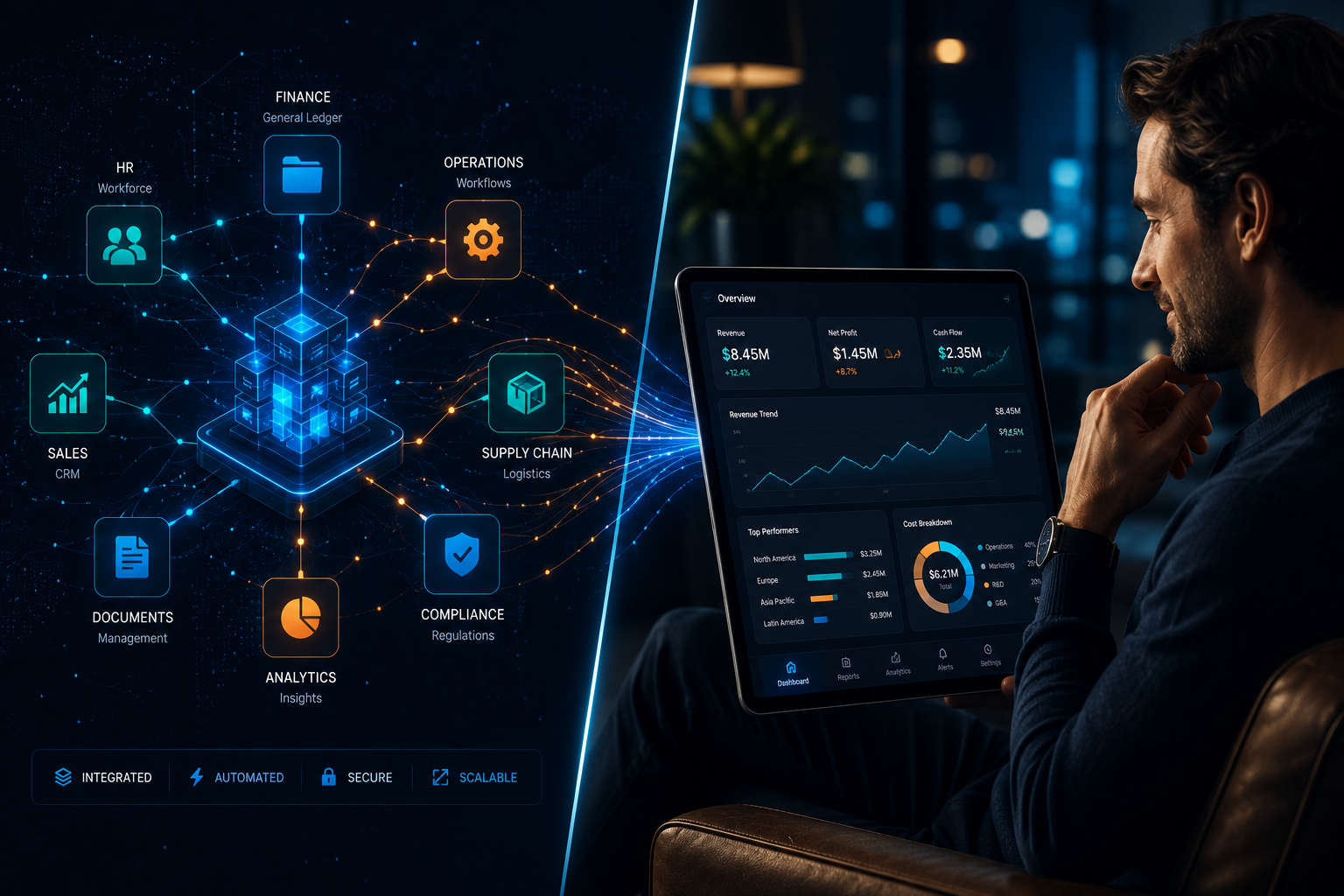
Recommended Thumbnail Image: Visual Concept: A sleek, modern split-screen illustration. On the left side, a glowing, abstract digital network connecting various corporate icons (folders, gears, charts). On the right side, a relaxed professional looking thoughtfully at a clean, simplified dashboard on a tablet. The color palette should utilize deep corporate blues with vibrant neon accents (like teal or orange) to symbolize the intersection of established business processes and futuristic tech.