For decades, financial software was built as a monolith. The database, the processing logic, and the user interface (UI) were tightly bound together into a single, rigid system. If a company wanted to change how a customer viewed an invoice or how an employee submitted an expense report, they were forced to alter the core financial system itself—a slow, expensive, and risky process.
The modern paradigm has shifted toward headless finance architecture. By utilizing Headless Finance API Integrations, organizations decouple the back-end financial engine from the front-end presentation layer. This objective guide explores how this decoupled architecture operates and why it is becoming the standard for agile technology deployments.
1. Deconstructing the Headless Architecture
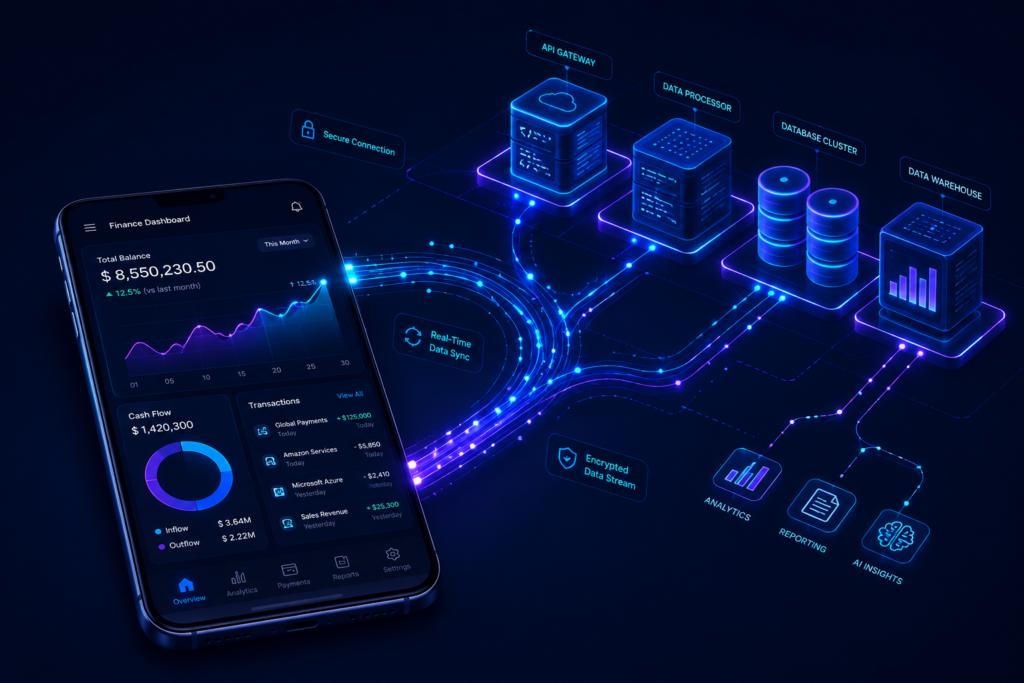
In a «headless» setup, the «head» (the front-end user interface, whether a website, a mobile app, or a custom internal portal) is completely separated from the «body» (the back-end ledger, payment processor, or ERP). They communicate exclusively via Application Programming Interfaces (APIs).
The Role of REST and GraphQL
Headless architectures rely on highly efficient API protocols to request and deliver data.
- RESTful APIs: The traditional standard, where the front-end requests specific data endpoints (e.g.,
/api/v1/invoices). - GraphQL: An increasingly popular query language for headless systems. It allows the front-end to request exactly the data it needs and nothing more. Instead of pulling an entire client file just to display an account balance, GraphQL fetches the balance alone, drastically reducing payload sizes and increasing application speed.
Microservices and Modularity
Headless finance rarely relies on a single back-end system. Instead, it utilizes microservices. A company might use one headless API for processing payments, another for calculating complex tax liabilities, and a third for managing subscription billing. The front-end weaves these distinct APIs together into a single, unified user experience.
2. Agility and the Custom User Experience
The primary advantage of headless finance is complete creative and functional freedom over the user experience. Because the UI is no longer constrained by the limitations of a monolithic ERP software vendor, developers can build fast, highly customized interfaces using modern frameworks like React, Vue.js, or Next.js.
If a business needs to launch a new B2B technical portal, they can design intuitive site menus, specific code-based content categories, and customized privacy policy layouts from scratch. The front-end focuses entirely on delivering a seamless digital experience, while the headless APIs silently handle the complex financial logic in the background.
3. Security and Scalability Advantages
Decoupling the architecture inherently improves system security. The front-end application never directly accesses the core database. It only communicates through strict API gateways, which can be protected by web application firewalls (WAF), rate limiting, and token-based authentication. If the front-end web server is compromised, the core financial ledger remains isolated and secure.
Furthermore, headless architecture allows for independent scalability. During peak traffic periods (such as the end of the fiscal quarter), the API processing layer can be scaled up dynamically without having to duplicate the entire front-end infrastructure.
💬 Interactive Perspective: Designing for the User
When architecting a technical B2B website, structuring site menus, code categories, and privacy policies requires a platform that doesn’t hold you back. Have you found that separating the front-end design from the heavy back-end processing gives you more freedom to optimize load times and create a truly customized user experience?
4. Frequently Asked Questions (FAQ)
Does implementing a headless finance architecture require a larger development team? Initially, yes. Monolithic systems offer «out-of-the-box» interfaces that require little development. A headless approach requires dedicated front-end developers to build the UI and back-end engineers to manage the API connections. However, the long-term agility and reduction in technical debt often offset the initial development costs.
Can legacy ERP systems be made headless? Yes, but it requires an abstraction layer. Many organizations use middleware or API gateways to create a modern API layer on top of legacy, on-premise ERPs, allowing modern front-end applications to interact with old systems as if they were natively headless.