As enterprises scale, the traditional approach to managing data—funneling all information from across the company into a single, centralized Data Lake managed by a siloed data engineering team—creates severe bottlenecks. The central team lacks the specific domain context to understand the data, leading to delays and inaccuracies in reporting.
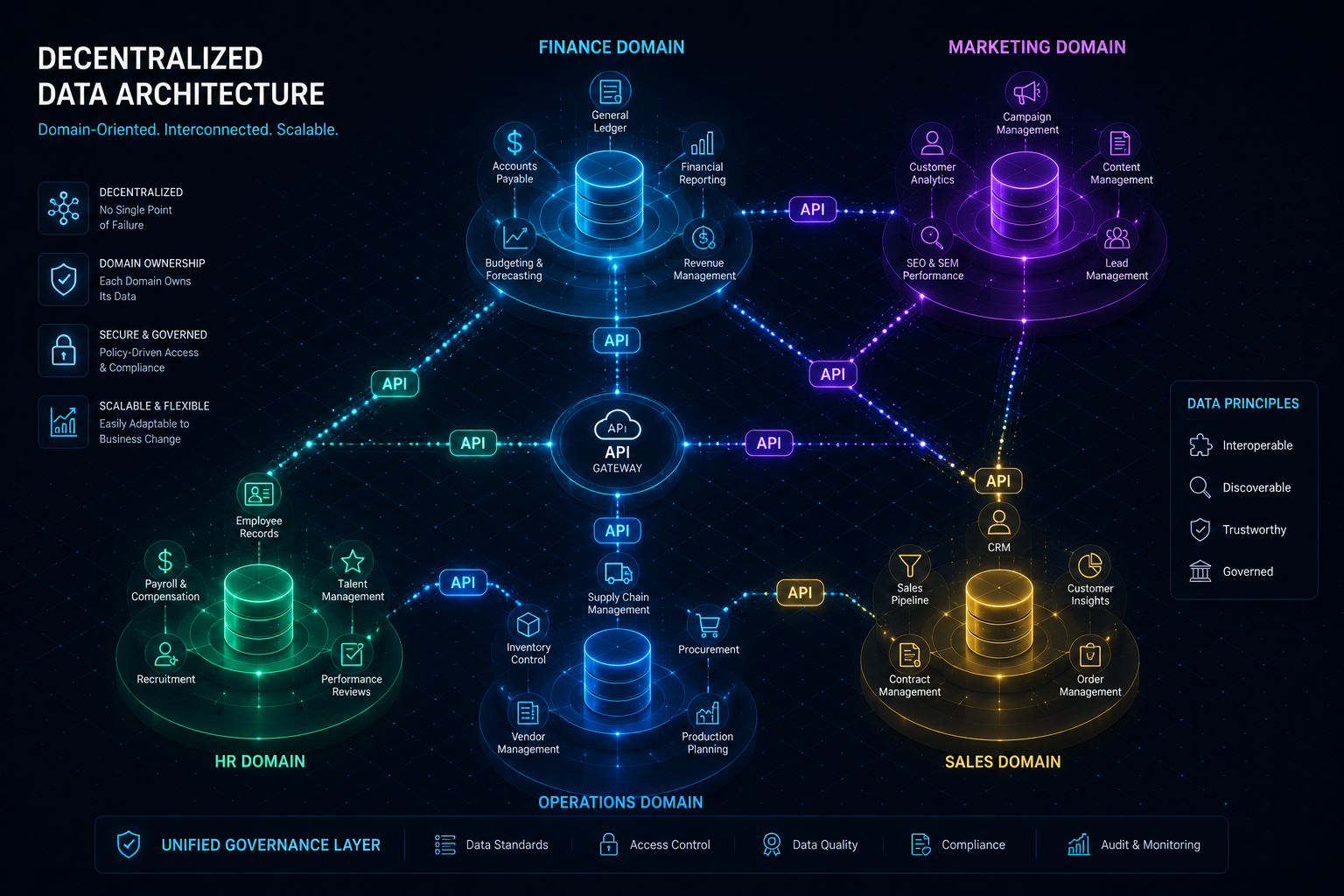
In 2026, forward-thinking organizations are adopting Data Mesh Financial Mapping. This architecture decentralizes data ownership, shifting the responsibility from a central IT team to the specific business domains that actually understand and use the data.
1. The Core Principles of a Data Mesh
A data mesh is a socio-technical architecture that treats data not as a byproduct of a process, but as a product itself. It is built on four foundational pillars:
- Domain-Oriented Decentralized Data Ownership: The accounting department owns the tax and ledger data; the HR department owns the payroll data; the marketing team owns the campaign performance data. Each domain is responsible for the quality, accuracy, and mapping of its own information.
- Data as a Product: The domain owners must package their data so it is easily discoverable, understandable, and securely accessible by other teams via standard APIs.
- Self-Serve Data Infrastructure as a Platform: A central engineering team provides the underlying agnostic infrastructure (storage, compute, API gateways) that allows the business domains to build and host their data products without needing to become database administrators.
- Federated Computational Governance: A standardized set of global rules (security, compliance, interoperability) that all data products must adhere to, ensuring the decentralized mesh doesn’t collapse into chaos.
2. Financial Mapping in a Decentralized World
In corporate finance, understanding complex structures—such as the rules of the Spanish General Accounting Plan (Plan General Contable), intricate amortization schedules, or macroeconomic forecasting models—requires deep subject-matter expertise.
When a centralized IT team attempts to build tables for these financial models, they often map the data incorrectly because they do not understand the underlying accounting principles. In a Data Mesh, the financial analysts themselves govern the mapping. They utilize self-serve tools to structure the raw financial data into a clean, queryable «Data Product.»
If the strategy department needs to run a macroeconomic forecast, they do not submit a ticket to IT. They simply query the «Amortization & Ledger» data product maintained by the accounting domain, knowing the data has been formatted by experts who understand the financial realities.
3. Improving Agility and Cross-Domain Analytics
Data mesh architecture fundamentally improves corporate agility. Because data is structured as accessible products, cross-domain analysis becomes frictionless. For example, a data scientist can seamlessly join the «Sales Volume» data product with the «Macroeconomic Indicators» data product to build predictive operational models, confident that the data mappings are accurate and well-documented by their respective domain owners.
💬 Interactive Perspective: The Value of Domain Expertise
When reviewing complex exam topics in university or managing real-world corporate ledgers, you quickly realize that understanding tax accounting rules and organizational design theories requires specialized knowledge. Do you agree that the people who deeply understand the financial principles (like amortization schedules) should be the ones directly controlling how that data is mapped and formatted for the rest of the company?
4. Frequently Asked Questions (FAQ)
Does a data mesh replace a data warehouse? Not necessarily. A data mesh is an architectural paradigm, not a specific software. Organizations can still use cloud data warehouses (like Snowflake or BigQuery) as the underlying infrastructure. The shift is in who builds and owns the tables within that warehouse (the decentralized domains rather than a central team).
How does an enterprise maintain data quality in a decentralized mesh? Data quality is maintained through strict Service Level Objectives (SLOs) applied to every Data Product. Just as a software application must maintain uptime and bug-free code, a data product must guarantee a certain level of freshness, accuracy, and availability, enforced by the federated computational governance rules.