In the rapidly evolving sectors of Finance Tech and Data Analytics, the sheer volume and velocity of information processed daily have rendered traditional, siloed software architectures obsolete. Today, businesses utilize an average of 93 different applications, making seamless data flow across systems not just a operational luxury, but an absolute necessity. To meet the demands of real-time analytics, composable infrastructures, and machine learning models, organizations are abandoning legacy integration models in favor of a transformative approach: API-First Data Ingestion.
This comprehensive guide explores the structural mechanics, strategic advantages, and security imperatives of prioritizing Application Programming Interfaces (APIs) at the very inception of software and data pipeline development.
1. The Paradigm Shift: From Code-First to API-First
Historically, APIs were treated as secondary communication layers—afterthoughts built merely to expose existing backend systems to external consumers or internal teams. This code-first approach often resulted in brittle, undocumented endpoints that functioned more like rudimentary glue code than scalable architecture.
API-first, conversely, is a development model in which applications are conceptualized and built with services that are strictly delivered through APIs. In this framework, organizations prioritize designing, documenting, and approving APIs at the beginning of the software development process, long before a single line of backend infrastructure code is written.
By positioning APIs as the foundational building blocks of the product rather than an integration afterthought, developers ensure that the underlying application can seamlessly and securely connect with both internal microservices and external third-party platforms.
2. Core Mechanics of API-First Data Ingestion
Transitioning a financial analytics platform to an API-first ecosystem requires a highly structured methodology focusing on contracts, decoupling, and centralized gateway management.
The API Contract and Specifications
The foundation of this approach is the API contract. Before development begins, stakeholders must align on the exact business use case of the API. Once aligned, teams define the necessary resources, data formatting, and endpoint methods, capturing these decisions in a standardized API definition. These definitions adhere to rigorous specifications, such as OpenAPI and AsyncAPI, providing a standardized, machine- and human-readable format that lays the groundwork for documentation, mocks, and automated testing.
Mocking and Automated Testing
A primary mechanical advantage of the API-first workflow is parallel development. Once the API definition is established, teams can instantly generate mock servers. These mock servers return sample data in response to requests, allowing frontend engineers or external partners to validate their assumptions and begin building consumer code immediately. Mocks can also be integrated into CI/CD pipelines to run automated tests, ensuring that issues are identified and remediated before they reach production consumers.
The API Gateway as the Command Center
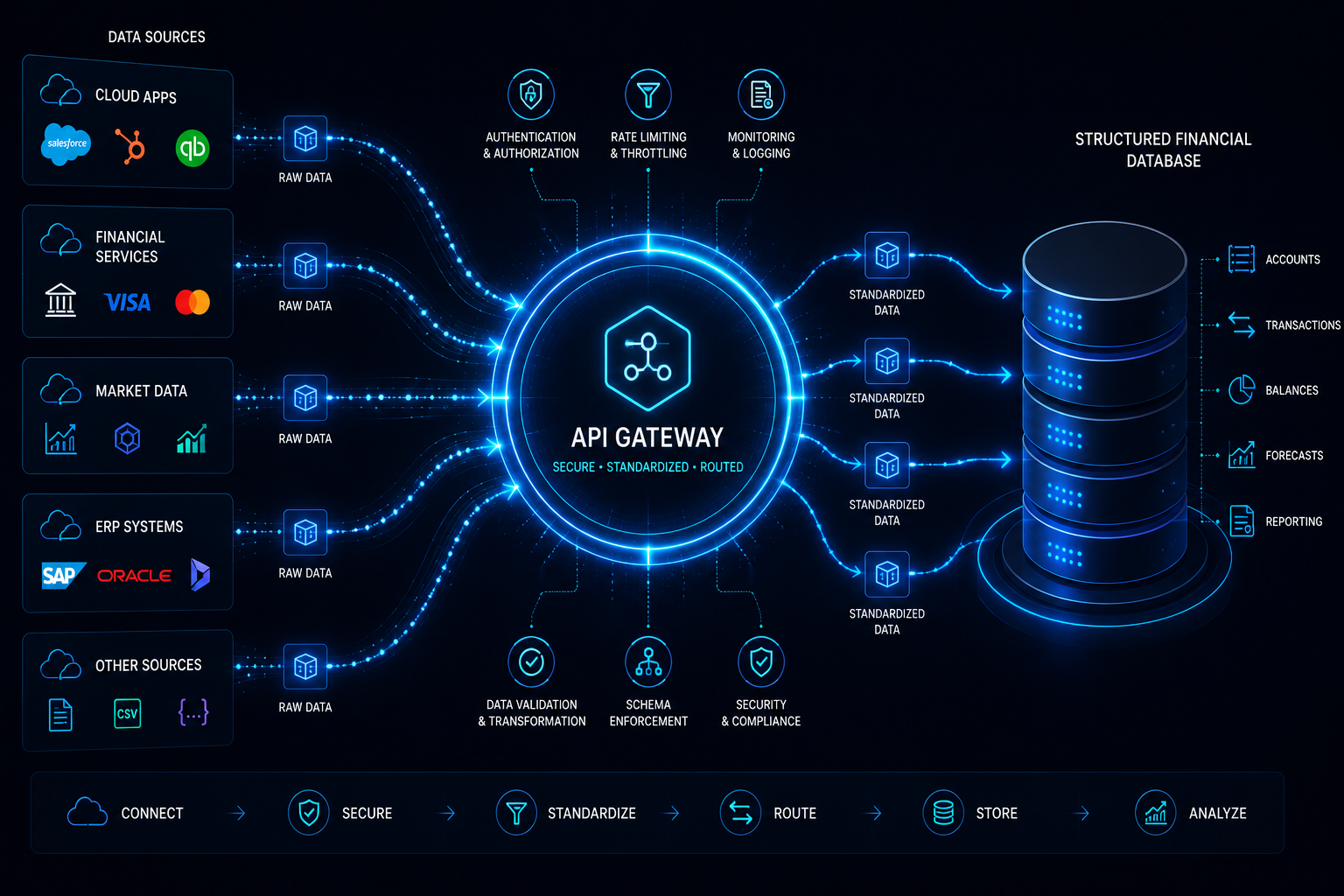
In a distributed microservices environment, the API Gateway operates as the brain of the integration architecture. All incoming and outgoing data ingestion traffic passes through this centralized node. The gateway undertakes critical operational tasks such as authentication, authorization, rate limiting, and traffic management. Furthermore, it enables the centralized deployment of security policies and version management across the entire ecosystem.
3. Strategic Advantages for Data Analytics Teams
Embracing an API-first strategy fundamentally alters how organizations leverage their data, offering massive competitive advantages in scalability and cross-team efficiency.
Establishing a Single Source of Truth
When an organization builds the API first and layers the user interface (UI) on top of it, the UI utilizes the exact same API to access and manipulate data as programmatic consumers. This creates a definitive single source of truth. In contrast, a code-first strategy often exposes only a small, developer-selected subset of data and functionality through the API, forcing teams to manipulate data through two different toolsets—a recipe for operational disaster and conflicting analytics.
Accelerating Composable Architectures
Modern data platforms rely on composable architectures, which involve combining independent services via APIs to create highly customizable tech stacks. API-first platforms provide full access to data and functionality, allowing teams to build complex, multi-service workflows without writing a single line of fragile «glue code». This generic, defined interaction heavily reduces the engineering resources required to accomplish unique integration goals.
Cross-Team Collaboration and Speed
By centralizing API workspaces—providing access to artifacts, documentation, and monitors—cross-functional collaboration improves drastically. For example, Moneris, a fintech company, reduced developer onboarding to production time from six months to just 72 hours by adopting an API-first strategy. Furthermore, operations, quality, and security engineering teams all experience quality improvements because bugs are caught and resolved before reaching the production environment.
4. Implementing API-First Ingestion: A Technical Roadmap
For enterprises ready to overhaul their data integration strategies, a structured implementation roadmap is vital.
- Inventory and Define Boundaries: The first step is to take a comprehensive inventory of existing databases, applications, and services to understand exactly how many APIs exist and where gaps remain. Organizations must also define their business domain boundaries and map their organizational structure to those boundaries to identify communication gaps.
- Align Architecture with Use Cases: Stakeholders must ensure the chosen architecture fits the objective. For instance, a gRPC-based architecture is highly effective for connecting internal microservices, whereas a GraphQL API is better suited for a service relying on disparate data sources.
- Continuous Observability: Because today’s developers are often drowning in a sea of logs and errors, modern environments require API-first observability. Utilizing passive network monitoring agents allows teams to automatically infer endpoints and detect active errors within minutes, without requiring invasive SDK installations or code changes. This allows teams to proactively address vulnerabilities before they affect consumers.
5. Security Imperatives for Financial Data
In the financial sector, where data integrity and privacy are paramount, traditional security models are no longer sufficient to protect dynamic data ingestion pipelines.
Centrally Defined Security Perimeters
Relying solely on firewalls and existing application security practices is inadequate for modern distributed systems. An API-first security perimeter is highly effective because every API and microservice has a security collection centrally defined by experts, which is then consistently applied by developers as a standard part of the API development lifecycle.
Data Masking and AI Consumers
Financial integrations handling sensitive information must incorporate dedicated data masking and encryption layers. This is especially critical as AI agents rapidly become the new primary consumers of APIs. An AI agent can interact with an API at machine speed with perfect persistence. In this environment, a single leaked token or an over-scoped API key can immediately create a system-wide vulnerability. Consequently, testing strategies must be multi-layered, integrating unit tests, integration tests, and performance load tests directly into the CI/CD pipeline.
6. Point of View: Scaling Analytical Architecture
When architecting a specialized web portal like FinanceStackHQ, structuring the backend for seamless data ingestion becomes a critical early decision. The transition from local data automation and advanced spreadsheet tools such as Excel and Power Query to a full-scale microservices ecosystem fundamentally shifts how information pipelines are managed. How do you plan to handle the authentication protocols and complex schema mapping as you integrate diverse, high-volume data sources into your analytics platform?
7. Frequently Asked Questions (FAQ)
What is the most critical metric for evaluating API success? The most important metric for a public API is Time to First Call (TTFC). This metric objectively measures the time difference between a developer’s point of discovery (such as signing up) and their first successful API call. Making this first call is the initial payoff that helps developers deeply understand how the API fits into their ecosystem. Failing to invest in optimizing the TTFC limits the size of the potential developer base throughout the adoption funnel.
Why is API-first better for creating composable applications? API-first treats the API as the core product, ensuring that the backend provides full programmatic access to all data and functionality. This allows developers to combine independent services (like translation microservices, headless CMS, and digital asset management systems) to build customizable tech stacks without writing fragile glue code.
How does an API-first approach impact the broader software market? The API-first philosophy is the central catalyst driving the growth of interconnected ecosystems, pushing the Integration Platform as a Service (iPaaS) market from an estimated $9 billion in 2024 to $17 billion by 2028. Furthermore, 65% of organizations now generate revenue directly from their APIs, proving that well-designed API programs function as powerful profit drivers rather than mere cost centers.