The landscape of artificial intelligence and enterprise automation is undergoing a structural shift. For years, organizations focused on deploying single, monolithic models or traditional robotic process automation (RPA) scripts to handle repetitive, isolated tasks. However, as business processes become increasingly complex and data-heavy, these fragmented approaches have hit a ceiling. The next phase of operational efficiency is defined by a more sophisticated framework: agentic data orchestration.
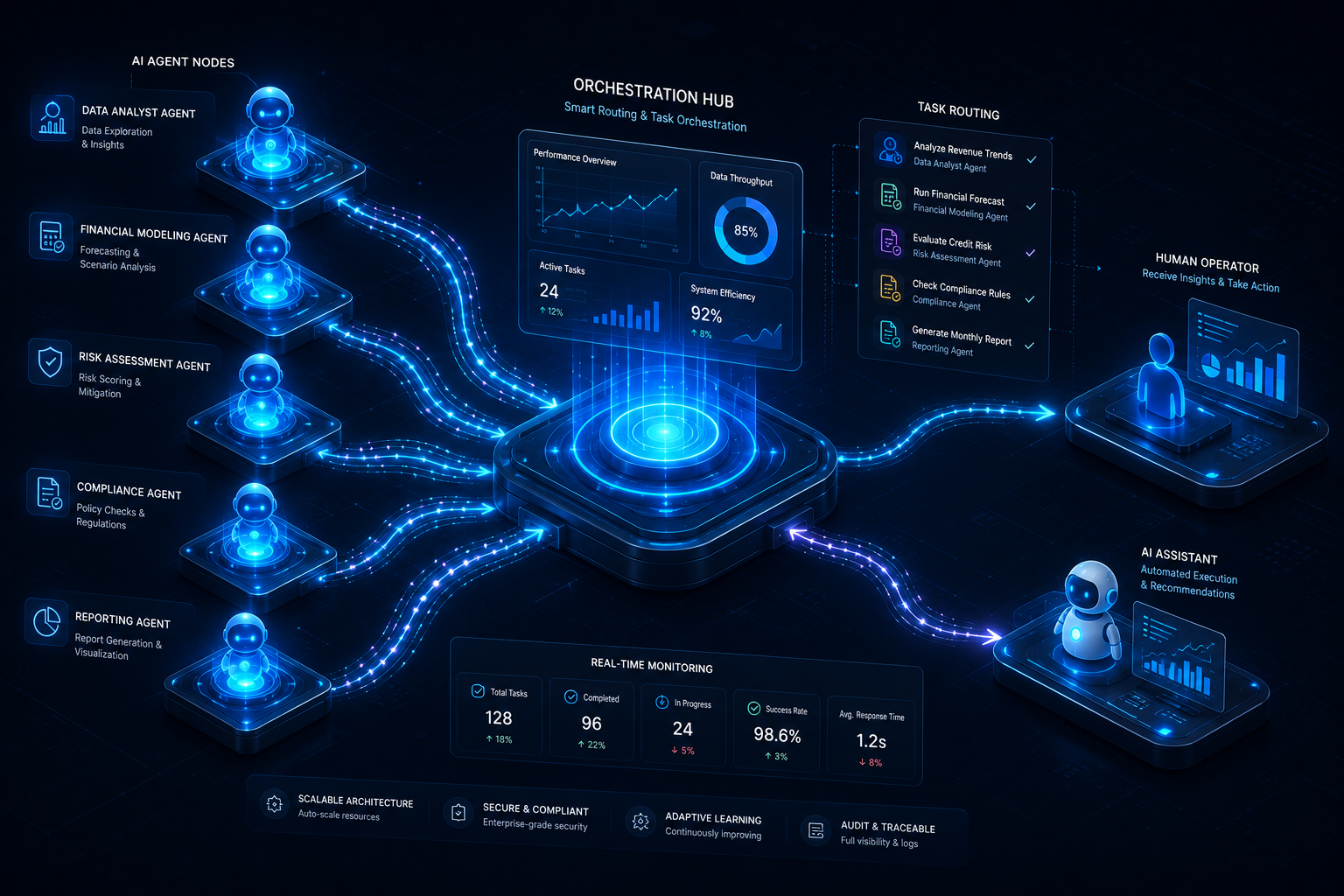
Agentic orchestration represents a significant evolution in AI, characterized by specialized agents collaborating to achieve complex goals. Rather than relying on rigid programming or standalone language models, this approach allows enterprises to coordinate, control, and optimize the work of multiple AI agents, RPA robots, and human personnel across end-to-end workflows.
This article explores the mechanics, benefits, and architectural considerations of agentic data orchestration, providing an objective analysis of how it transforms data workflows and enterprise operations.
1. Understanding the Shift from RPA to Agentic Orchestration
To grasp the impact of agentic orchestration, it is essential to understand its departure from traditional automation. RPA has historically served as the connective tissue between legacy systems and modern applications, automating highly predictable, rules-based tasks. However, RPA lacks cognitive adaptability; if a user interface changes or data is presented in an unstructured format, traditional bots often fail.
Agentic orchestration bridges this gap by integrating generative AI and large language models (LLMs) to enhance natural language understanding and cognitive flexibility. It goes beyond standard process orchestration to ensure that autonomous AI agents are fully integrated into the enterprise equation. This integration provides the necessary visibility, rules, and oversight to ensure that agents drive value without introducing operational risk.
The Power of Multi-Agent Collaboration
A defining characteristic of agentic orchestration is the transition away from single-model thinking. Research and practical applications consistently demonstrate that specialized agents working in parallel outperform single, generalized models on complex, interconnected tasks.
In a multi-agent system, tasks are routed to the most capable specialist. For example, one agent might handle data extraction, while another executes compliance checks, and a third formulates a decision matrix. These agents share insights, catch errors, retry failures, and hand off clean outputs, mirroring the collaborative dynamics of human engineering teams.
2. Core Architectural Components
The infrastructure supporting agentic orchestration relies on several foundational technologies and methodologies working in unison.
Collaborative Systems and Process Intelligence
At the heart of agentic orchestration are specialized AI agents—whether focused on logistics, customer analytics, or financial auditing—that adapt to real-time changes. Instead of a single centralized engine, this architecture utilizes integrated process intelligence to coordinate agents, bots, and humans.
Organizations leverage industry standards like business process modeling and notation (BPMN) 2.0 to clarify and model workflows, alongside decision model and notation (DMN) to manage business rules and deterministic logic. This ensures that every action taken by an AI agent remains within defined operational boundaries.
Seamless Integration and API Connectivity
Agents are only as effective as the data they can access. When information is trapped in siloed systems, the continuity of agentic workflows suffers. Agentic orchestration utilizes robust APIs and RPA to flow data effortlessly across platforms. In advanced enterprise setups, this is often supported by container orchestration using Kubernetes or integration with specialized cloud services to streamline cross-platform data execution.
Production-Ready Scalability
Historically, achieving «production-ready» status required months of hardening prototypes and configuring infrastructure. Today, production scalability is considered a starting point rather than an endgame. Modern agentic systems are increasingly Kubernetes-native and containerized from day one, equipped with continuous integration and continuous deployment (CI/CD) pipelines to handle sustained inference and complex orchestration without losing architectural coherence.
3. Real-World Applications and Outcomes
Agentic orchestration shifts the focus from automating individual tasks to coordinating complete business outcomes. This capability is actively transforming several critical sectors:
- Supply Chain Intelligence: Organizations coordinate specialized agents for demand forecasting, inventory optimization, and logistics planning to achieve end-to-end efficiency.
- Risk Management and Compliance: By integrating fraud detection agents with compliance monitoring tools, enterprises can conduct comprehensive risk assessments and mitigate threats dynamically.
- Financial and HR Operations: Agentic orchestration is highly effective in streamlining payroll processes and intelligent document processing. By coordinating robots, AI, and human validation (human-in-the-loop), organizations can execute conditional tasks and extract information from unstructured documents flawlessly.
4. Mitigating Risks: Governance, Security, and Agent Sprawl
Despite its potential, the deployment of autonomous systems introduces new challenges. According to industry analysis, agentic AI has reached a point of intense market attention, yet many organizations struggle with execution. A major emerging concern is the need for strict governance, security, and cost management.
Preventing Agent Sprawl
As teams begin building autonomous systems, there is a significant risk of «agent sprawl»—the rapid proliferation of disconnected agents operating without unified visibility, controls, or governance. To prevent this, organizations must design and model their processes meticulously before deploying agents. Identifying expected handoffs, gaps, and areas requiring human judgment creates a structured foundation that avoids unnecessary complexity.
Enforcing Deterministic Logic and Accountability
Mission-critical work cannot afford unpredictable AI behavior. Advanced orchestration platforms ensure that operations remain reliable by enforcing deterministic logic and strict validations for every action. This means every decision made by an AI agent must be documented, explainable, and fully compliant with regulatory standards.
By maintaining a «human-in-the-loop» protocol, professional human judgment is applied precisely where it is needed, ensuring that AI acts as an accelerator rather than an unchecked decision-maker.
5. Strategic Implementation Best Practices
For organizations planning to integrate agentic data orchestration into their architecture, a methodical approach is critical.
- Unlock Trapped Data: The first step is to digitize and structure data trapped in unstructured documents, such as invoices, contracts, and service requests. A rich, accessible data foundation is strictly necessary for agents to understand the context of what needs to happen next.
- Design for the End-to-End Process: Adopting agentic AI is not about inserting an agent into a single step; it requires reimagining the entire workflow. Organizations should use process intelligence to map out current bottlenecks and orchestrate a unified workflow that adapts in real time.
- Establish Robust AI Governance: Establish clear standards for how AI models are used, track the data they can access, and set firm access controls. Transparency, auditability, and responsible use must be baked into the orchestration layer.
Conclusion
Agentic data orchestration is redefining the boundaries of enterprise automation. By shifting from single-model execution to collaborative, multi-agent ecosystems, organizations can achieve scalable intelligence and dynamic adaptability. However, true success in this domain requires more than simply deploying agents; it demands a comprehensive strategy centered on seamless data integration, rigorous governance, and intentional process design. As the technology matures, the enterprises that master the orchestration of agents, robots, and humans will hold a decisive operational advantage.
Frequently Asked Questions (FAQs)
What is the difference between traditional RPA and agentic orchestration? Traditional Robotic Process Automation (RPA) excels at executing repetitive, rules-based tasks but lacks the ability to adapt to unexpected changes or unstructured data. Agentic orchestration incorporates cognitive AI agents that can understand natural language, make contextual decisions, collaborate with other agents, and dynamically reroute tasks based on real-time information.
How does agentic orchestration prevent AI hallucinations and errors? It prevents errors through strict governance and process modeling (like BPMN and DMN). Orchestration layers enforce deterministic rules, meaning the AI must operate within pre-defined boundaries. Additionally, complex or high-risk decisions are routed to human workers (human-in-the-loop) for final validation.
Can small to mid-sized enterprises (SMEs) benefit from agentic data orchestration? Yes. While large enterprises are early adopters due to their complex data silos, SMEs can leverage cloud-based agentic orchestration platforms to automate resource-heavy tasks like customer service routing, invoice processing, and supply chain tracking without needing massive internal engineering teams.
Interactive Point of View: Over to You
Reflecting on the evolution of data architecture, how is your organization currently managing the handoff between automated scripts (like Python or traditional RPA) and human decision-making? Are you finding that data silos are creating bottlenecks that simple automation can no longer fix? Let us know your experience with process automation in the comments.